Golden Circle Attractions
From UNESCO heritage sites to volcanic craters and natural hot springs — discover every stop along Iceland's most famous route.
The Big Three
The three iconic attractions that define the Golden Circle.

Geysir Geothermal Area
A protected hot spring field in the Haukadalur valley, home to the Great Geysir and Strokkur, which erupts every few minutes. Free to walk and ten minutes from Gullfoss.

Gullfoss Waterfall
A two-stage waterfall on the glacial Hvítá river, where an average of 109 cubic metres of water a second drops 31 metres into a narrow canyon. The last of the three classic Golden Circle stops.

Þingvellir National Park
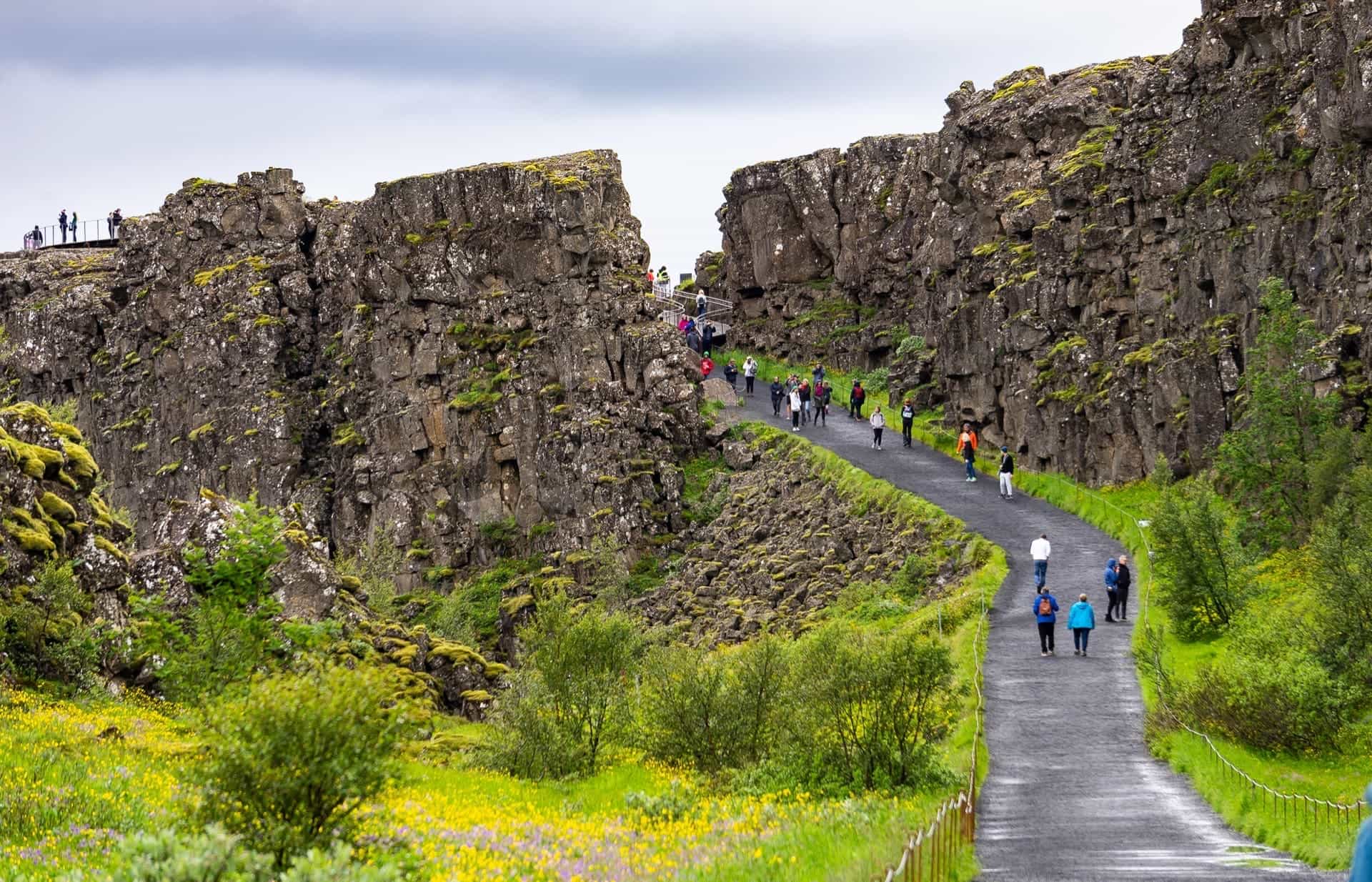
Iceland's first national park and the site of the Alþing from 930 to 1798, set in a rift valley on the first stop of the Golden Circle.
More Attractions
Popular stops and hidden gems along the Golden Circle route.

Almannagjá Gorge
The long fault gorge on the western edge of the Þingvellir rift valley, with a walking path from the Hakið viewpoint down to the old assembly site.

Bjarnarfell Mountain Hike
A 727-metre hyaloclastite ridge rising behind the Geysir hot springs in Haukadalur. An unmarked half-day climb for experienced walkers, with views across south Iceland.

Blue Lagoon
The Blue Lagoon is Iceland's world-famous geothermal spa, set in a dramatic lava field on the Reykjanes Peninsula. Its signature milky-blue waters are rich in silica, algae, and minerals — making it one of the most iconic bathing experiences on earth.

Brúarfoss Waterfall
A low, wide waterfall on the spring-fed Brúará river, famous for its blue water and a short walk from a paid car park off Route 37. A longer riverside trail suits hikers in summer.

Brúarhlöð Gorge
A short, narrow gorge where the glacial Hvítá squeezes between pillars of volcanic breccia, beside the Route 30 bridge 12 km south of Gullfoss. A ten-minute roadside stop on the way to Flúðir.

Efstidalur
A family dairy farm above Laugarvatn with an ice cream bar looking into the cowshed, a farm-to-table restaurant, horse rides and rooms. An easy lunch stop between Þingvellir and Geysir.

Eyrarbakki
Eyrarbakki is a beautifully preserved coastal village in South Iceland, once a rival to Reykjavík, now home to Iceland's oldest wooden house and a charming maritime heritage.

Faxi (Vatnsleysufoss) Waterfall
A broad, low waterfall on the Tungufljót river, 11 km south of Geysir, with a salmon ladder along one bank. A quick, quiet stop just off Route 35.
Flúðasveppir Mushroom Farm and Farmers Bistro
Iceland's only mushroom farm, on the edge of Flúðir, with a restaurant that serves a mushroom soup buffet and dishes made from the farm's mushrooms and peppers.

Flúðir
A geothermal farming village in Hrunamannahreppur, south of Gullfoss and Geysir. Home to the Secret Lagoon, Iceland's only mushroom farm and some of the country's busiest greenhouses.

Friðheimar Tomato Farm
A family-run geothermal greenhouse in Reykholt where tomatoes grow all year under lights and lunch is served among the plants. Famous for its tomato soup and bread buffet.

Garðabær
A prosperous coastal town in Greater Reykjavík, Garðabær blends Viking-age history, the President of Iceland's official residence, and easy access to lava fields and shoreline walks.

Gljúfrasteinn – Laxness Museum
The home of Nobel laureate Halldór Laxness, kept as he left it, beside Route 36 in Mosfellsdalur on the way from Reykjavík to Þingvellir.

Hafnarfjörður
A charming harbour town just south of Reykjavik, Hafnarfjörður blends ancient lava landscapes, Viking heritage, and Iceland's richest elf folklore into one compact and very walkable destination.

Haukadalur Valley
The valley that holds the Geysir hot springs, with an old wooden church, one of south Iceland's largest forests and a long history as a centre of learning. A quiet walk a kilometre from Strokkur.

Hellisheiði Power Plant and Geothermal Exhibition
Iceland's largest geothermal power plant, on Route 1 about 25 km east of Reykjavík, with a self-guided exhibition on how the country turns volcanic heat into electricity and hot water. An easy indoor stop on the way to or from the Golden Circle.

Hruni Church (Hrunakirkja)
A protected 1865 timber church on the old Hruni estate, about 5 km east of Flúðir. Known across Iceland for the folk tale of the dance at Hruni.

Hvítá River
The glacial "white river" that flows from Hvítárvatn at Langjökull, over Gullfoss and through the farmland of the Golden Circle before joining the Sog to become the Ölfusá at Selfoss.

Kerið Crater
A red-walled volcanic crater with a green-blue lake on Route 35 in Grímsnes, 16 km north of Selfoss. It is the easiest extra stop to add to a Golden Circle day.

Lake Úlfljótsvatn
A small lake on the Sog river just south of Þingvallavatn, with a lakeside church, the national scout and adventure centre and the Ljósafoss power station. It links the Þingvellir area to Kerið and Selfoss.

Lake Þingvallavatn
Iceland's largest natural lake, filling the rift valley south of the old parliament site at Þingvellir. Fed almost entirely by spring water, it is home to four forms of Arctic char.

Langjökull Glacier
Iceland's second-largest ice cap, rising in the highlands north of Gullfoss. Its meltwater feeds the Hvítá and Gullfoss, and guided trips reach the ice from the Golden Circle.

Laugarvatn
A small village on a geothermally warmed lake, halfway between Þingvellir and Geysir. Good for a lakeside walk, a meal, a swim or a night off the main loop.

Laugarvatn Fontana
A geothermal spa on the shore of Lake Laugarvatn, reopened in August 2026 after a full renovation. Steam rises from a hot spring under the floor and the baths run out into the lake.

Laugarvatnshellar (Laugarvatn Caves)
Two rooms carved into a soft rock outcrop between Þingvellir and Laugarvatn, the last place in Iceland where people lived in a cave. Now rebuilt and shown on 25-minute guided tours.

Laugarás Lagoon
A two-level geothermal lagoon on the banks of the Hvítá in Laugarás, opened in October 2025, with a waterfall, saunas, swim-up bars and the Ylja restaurant. It sits 4 km from Skálholt, between Kerið and Geysir.

Lögberg, the Law Rock
The traditional site of the Law Rock at Þingvellir, where the Alþing's Law Speaker recited the laws and anyone could address the assembly, marked today by a flagpole above Almannagjá.

Nesjavellir Geothermal Area
A steaming high-temperature field and power station on the northern slopes of Hengill, above the southern shore of Þingvallavatn. The plant is closed to visitors, but the roads, viewpoints and Hengill trails are open.

Reykholt (South Iceland)
A geothermal greenhouse village in Bláskógabyggð, on Route 35 between Selfoss and Geysir. Best known as the home of Friðheimar's tomato farm restaurant.

Reykjadalur Hot Spring Valley
A geothermal valley in the Hengill hills above Hveragerði, where a warm river you can bathe in sits about 3 km up a walking trail. It is free to enter, with paid parking at the trailhead.

Reykjavik
Iceland's vibrant capital city is the perfect base for Golden Circle day tours — a compact, walkable city full of colour, culture, and geothermal energy.

Secret Lagoon (Gamla Laugin)
Iceland's oldest swimming pool, built in 1891 at a hot-spring field beside Flúðir. Spring water keeps it at 38–40°C all year, and a small geyser erupts at the pool's edge.

Silfra Fissure
A spring-fed fissure in the rift valley at Þingvellir, filled with glacier water filtered through lava for decades, where you can snorkel or dive with a licensed guide.

Sky Lagoon
A stunning oceanfront geothermal spa near Reykjavik with an infinity-edge lagoon and the signature 7-step Skjól Ritual rooted in Icelandic bathing tradition.

Skálholt
Iceland's main bishop's seat for over 700 years, now a free-to-visit cathedral, crypt museum and turf chapel by the Hvítá river. It sits a short detour off Route 35 between Kerið and Geysir.

Stokkseyri
A characterful coastal village on Iceland's South Shore, beloved for crashing Atlantic breakers, Icelandic folklore museums, and some of the country's most celebrated lobster.

Sólheimar Ecovillage
A sustainable community of about 100 people in Grímsnes, founded in 1930, where residents with and without disabilities live and work together. Visitors can walk around, shop for crafts and eat at the organic café.

Öxarárfoss Waterfall
The waterfall where the river Öxará drops into Almannagjá gorge, a short walk from the old assembly site at Þingvellir.

Þingvallakirkja and Þingvallabær
The small 1859 church on the old assembly plain at Þingvellir and the five-gabled farmhouse beside it, now the prime minister's summer residence.

Þórufoss Waterfall
A broad waterfall dropping into a basalt canyon on the Laxá í Kjós river, a short detour north of Route 36 on the drive from Reykjavík to Þingvellir.